
金陵十三钗
Chinese team develops intelligent vision sensor that turns light signals into AI-ready tokens, reducing use of energy_我的网站

一 |
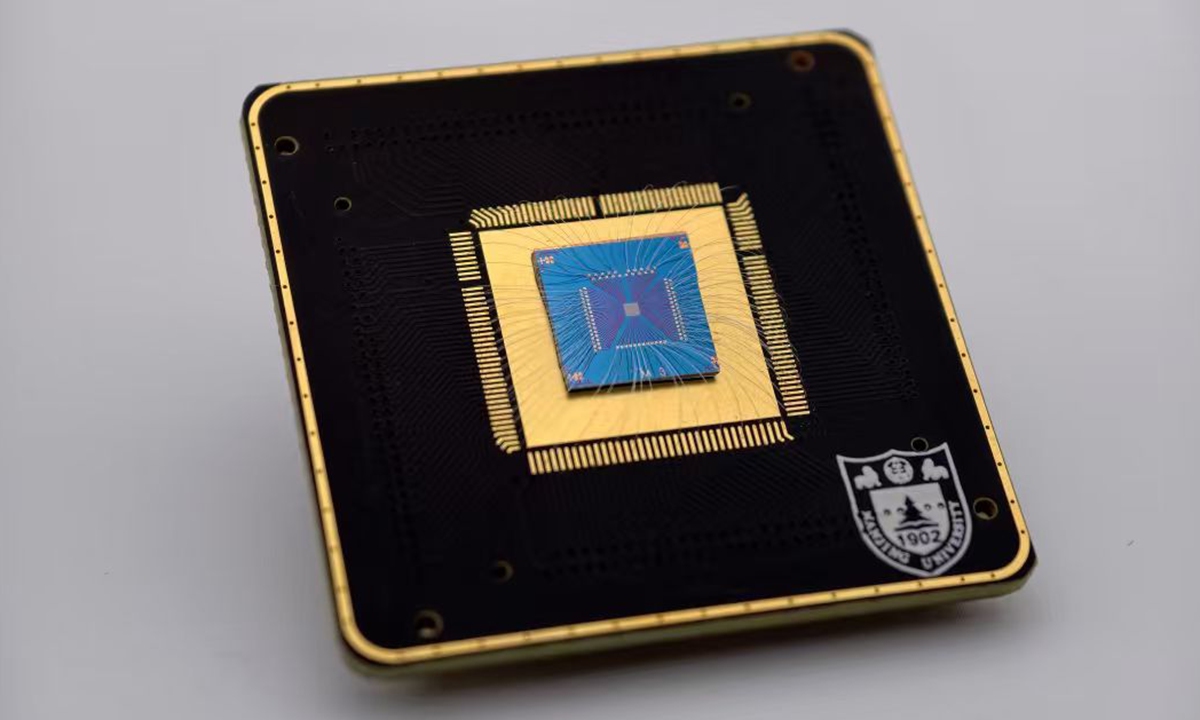
A Chinese research team from Nanjing University has developed a new ultra-low-power intelligent vision sensor chip, dubbed "LightTok," that can convert light signals into tokens within the sensor, significantly reducing the high energy consumption caused by frequent transfers of massive amounts of redundant data, the principal investigator told the Global Times.
According to a release from the Institute of Brain-Inspired Intelligence of Nanjing University, tokens generated by the LightTok chip can be directly fed into a Transformer encoder for image recognition.
"Our design idea was to move token generation onto the sensor itself, allowing the chip to directly produce tokens that AI models can process once light reaches the sensor," Miao Feng, director of the Institute of Brain-Inspired Intelligence at Nanjing University, told the Global Times on Thursday. "These tokens contain complete image information."
Physical AI refers to intelligent systems capable of autonomously perceiving, reasoning, acting and receiving feedback in the real world, representing a key pathway for AI to move from the digital realm into the physical world. Vision-based physical AI systems powered by large AI models need to convert visual information from real-world environments into tokens that can be processed by AI models before feeding these tokens into Transformers for subsequent tasks.
In traditional visual perception pipelines, light signals must go through multiple stages, including image sensing, analog-to-digital conversion, data buffering and transfer, digital image patching and embedding, before being transformed into tokens that AI models can process. The frequent transfer of massive amounts of redundant data has resulted in high energy consumption at the edge, according to a report by Science and Technology Daily.
The LightTok chip directly addresses a key challenge in physical AI hardware: how to efficiently acquire and tokenize visual information from the physical world with low energy consumption, Miao said.
The LightTok chip consists of a photosensitive memory array and peripheral circuits. The team built the array based on single-layer molybdenum disulfide (MoS₂) floating-gate phototransistors, with each pixel capable of sensing light, storing information and performing analog computing. By processing optical information directly within the chip, the device can convert captured visual signals into tokens for AI models, according to the research team.
The current LightTok prototype has a resolution of 32×32 pixels, or 1,024 photosensitive pixels, which is still smaller than that of smartphone cameras and industrial imaging systems. However, Miao said the technology is compatible with CMOS manufacturing processes and can be scaled up. With wafer-level growth of molybdenum disulfide materials, the chip could potentially achieve a scale comparable to existing imaging devices.
Miao said the chip also draws inspiration from the information-processing mechanism of human vision. Similar to how the retina extracts key visual information before transmitting it to the brain, the chip also aims to process visual information at an early stage.
The research was conducted in collaboration with another research team from the National University of Singapore. The findings were published on Wednesday in Nature Sensors, an internationally renowned journal in the field of sensing technology, according to the release.
Potential applications for LightTok include drone systems, autonomous remote sensing and small-scale embodied AI systems, Miao said. In these scenarios, devices need to continuously detect, understand and track targets, generating massive amounts of visual data. By reducing the energy required for visual processing, the technology could extend the operating time of drones, satellites and small robots with limited power supplies, the expert said.
。
据新华社援引伊朗媒体报道,载有伊朗总统莱希和高级官员的一架直升机19日发生事故,在伊朗西北部东阿塞拜疆省紧急降落。目前机上人员情况未明,搜救工作正全力展开。
据报道,同行的机队一共有3架直升机,其余两架直升机已经安全降落到伊朗城市大不里士(又译“塔布里兹”),伊朗能源部长梅赫拉比安、住房和城市发展部长巴兹帕什都已平安达到。但剩下一架直升机发生“硬着陆”,包括伊朗总统莱希、伊朗外交部长阿卜杜拉希扬和伊朗东阿塞拜疆省长拉赫马蒂在内的多位高级官员都在这架直升机上。

二 |
据伊朗IRNA通讯社报道,总统莱希所在的直升机上的2名同行人员已与搜救队伍取得联系。另据伊朗媒体塔斯尼姆报道称,东阿塞拜疆省长拉赫马蒂已成功与救援人员取得联系。据报道,拉赫马蒂说他感到非常痛苦,并且能听到警报声。媒体尚未透露有关总统莱希的任何信息。
伊朗红新月会方面表示,他们派出了4支救援队伍前往确定的事故地点坐标搜寻,但当地位于一片自然保护区内,树林茂密,而且天气潮湿且大雾弥漫,目前搜救工作尚无突破性进展。伊朗法尔斯通讯社表示,土耳其方面派出的无人机侦测到了一处热源,疑似为事故地点。伊朗红新月会已派出搜救队伍向该地点前进。
伊朗媒体报道称,根据俄罗斯总统普京的命令,俄罗斯方面派出两架先进飞机、直升机和50名专业山地救援人员前往伊朗帮助搜救。此外,欧盟危机管理专员雅内兹·莱纳尔契奇称,欧盟已经启动了“哥白尼快速反应测绘服务”,以帮助搜寻直升机。哥白尼监测系统是用于提供卫星图像的测绘产品。

三 |
Current article:http://teemw.laonenpeidiebenhuaiyunnangshi.cfd/qhe2/20260826/135615.html
Published on:00:00:00


